


Many websites today enjoy strong visibility on Google. Their pages appear in thousands of searches every month, rankings seem stable, and impressions continue to rise. Yet traffic does not grow at the same pace. This problem of the high impressions but low clicks is one of the most common and misunderstood SEO challenges.
What are high impressions low clicks SEO causes, how to diagnose them using Google Search Console, and how to turn visibility into organic clicks and organic search traffic, not just higher rankings? Let’s find out.
Impressions represent the number of times a page from your site appears in Google’s search results. This is a visibility metric, which tells you how often your content is shown, not whether anyone engages with it.
Clicks measure the number of times users actually click your listing and visit your site from search results. Clicks reflect the user’s interest and relevance.
CTR (Click-Through Rate) is calculated as:
CTR = (Clicks ÷ Impressions) × 100
CTR indicates how effective your listing is at converting visibility into engagement. This is why organic CTR optimization has become a core SEO objective, because rankings alone no longer guarantee traffic.
Google increasingly measures satisfaction, not just relevance. If users repeatedly skip your result in favour of others, Google interprets this as a weaker match to search intent. Over time, this can reduce your rankings and your long-term organic visibility.
More importantly, impressions without clicks deliver no business value. They create awareness, but they do not generate leads, sales, or growth. That is why modern SEO focuses on strategies to improve click-through rate in Google Search, not just ranking positions.
Several factors can cause your pages to appear frequently in search results yet attract very few clicks.
A page may rank for a term that generates impressions, but if it does not match what users are actually seeking, clicks remain low. For example, users with buying intent will skip an informational article even if it ranks highly. Google sometimes ranks pages for loosely related queries, inflating impressions without engagement.
Title tags and meta descriptions are the first elements users see and influence their decision to click. Vague or generic titles that fail to convey value, uniqueness, or relevance suppress clicks even when rankings are strong.
Visual enhancements like star ratings, FAQs, product details, and images attract more attention. Pages without structured data appear plain and are easier to overlook. Rich snippets boost visibility, trust, and perceived relevance, which directly increases organic click-through rates.
Even well-ranked pages can be overlooked if the search results page is crowded with paid ads, featured snippets, People Also Ask boxes, image packs, or AI-generated answers. When users find answers without scrolling, impressions stay high but clicks drop, particularly for informational queries.
Some searches, such as definitions, calculations, or quick facts, are answered directly on the results page. In these cases, impressions rise, but clicks remain low, reflecting a structural limitation rather than a content failure.
Unappealing or low-quality title tags, strong competitor listings, low trust signals, and pages ranking low on page one all reduce clicks. Even high-ranking pages can underperform if they lack credibility, a clear value proposition, or motivation for users to engage.
When a page gets impressions but few clicks, it usually signals an expectation mismatch. The page is showing up, but what people see on Google doesn’t convince them it’s worth their time.
Fixing this often doesn’t involve “doing more SEO.” In most cases, we need to ensure the search listing answers exactly what people are looking for.
Below are the most effective ways to close that gap.
Many pages appear on Google with vague or generic titles like:
“Our Services | Company Name” or “Complete SEO Solutions”
These get impressions because they rank, but they don’t get clicks because they don’t promise a result.
What works better:
This alone can significantly improve click-through rates.
A common reason for low clicks is ranking for the wrong type of intent.
For example:
People searching for that phrase often want:
If the title and description don’t reflect that, they scroll past, even if you rank well.
Meta descriptions aren’t a ranking factor, but they strongly influence clicks.
Instead of listing services, they should:
Example:
❌ “We offer comprehensive SEO services across industries.”
✅ “See why businesses choose us to turn Google visibility into consistent website traffic.”
People click what feels credible.
Small signals can make a big difference:
These don’t just help SEO, but also help users feel confident before clicking.
Tools like Google Search Console show:
Instead of rewriting everything, high-performing SEO teams focus only on:
That’s how small, targeted changes create noticeable traffic gains.
If your site already appears on Google but isn’t getting clicks, the opportunity is closer than you think. Focus on improving how your pages are presented and that might be enough to turn visibility into real traffic.
Simply because we have fixed the problem of high impressions and low clicks for our clients. As a trusted SEO agency in Kolkata, we have a proven track record of driving organic search traffic.
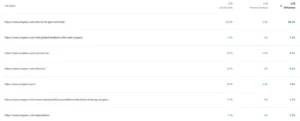
The snapshot below shows the average clickthrough rates of some of our clients’ website pages. While these pages were already appearing frequently on Google, few people were clicking on them. By applying site-wide and page-level strategies, combined with targeted insights from Google Search Console, we helped turn the high impressions into meaningful organic clicks.
Fixing low CTR is not about chasing rankings. If you’re facing this issue, it could be for many reasons. Do you need specific answers and recommendations for optimising your website for improved click-through rates? Our SEO experts can help. Get in touch with us today!
Yes, they signal authority and relevance, but real traffic and conversions come from clicks.
Quarterly review ensures meta tags optimization aligns with evolving search trends.
Properly structured rich snippets increase visibility and improve CTR.
Matching content to the user’s search purpose ensures impressions convert into clicks.
Changes can appear in 30-60 days, depending on crawl frequency and competition.